Erased: Is It Worth Watching?
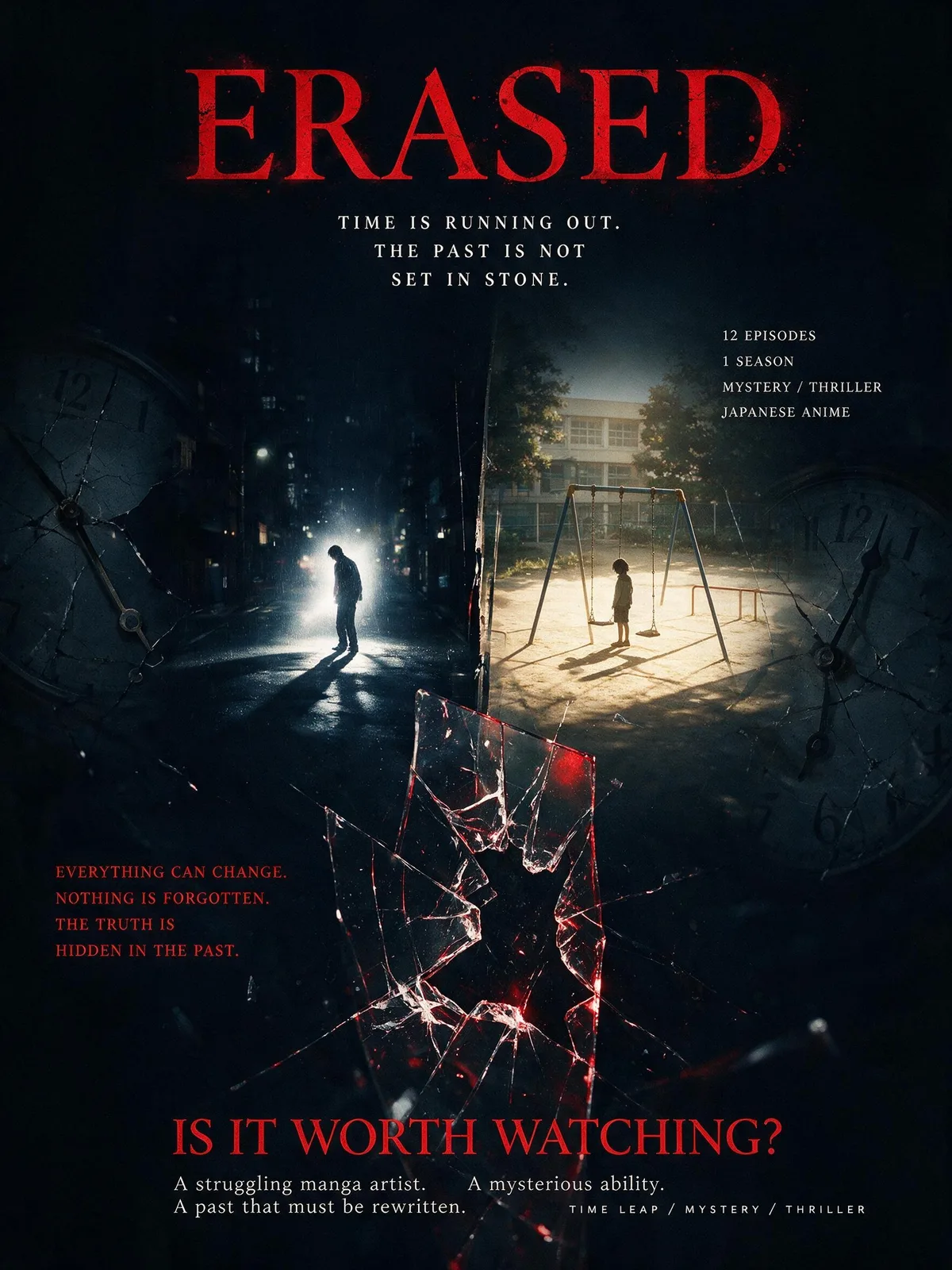
TL;DR — Erased follows Satoru Fujinuma, a struggling manga artist with an involuntary ability to travel back in time moments before a tragedy occurs, who's suddenly sent back 18 years to his own childhood to prevent a genuinely devastating kidnapping and murder case that shaped his entire life. One 12-episode season exists. Here's what makes this genuinely tense mystery-thriller hold up so well, and why its central mystery structure rewards careful attention.
Get anime picks based on this article
Want a tightly plotted mystery that plays fair? Skip the guide and jump straight to picks built for that.
Get anime picksTell us your mood. We'll do the picking.
8 quick questions. Real anime picks from real catalogs — not ads. Free, no sign-up.
Take the quizWhat's the actual premise?
Satoru possesses an involuntary power he calls "Revival," automatically sending him back several minutes before a tragedy to prevent it, a power he's used mostly for small, quiet interventions in ordinary life. After his mother is murdered under circumstances connecting to his own framing for the crime, Satoru is unexpectedly sent back 18 years to his elementary school years, discovering he has a chance to prevent the actual root cause, a serial kidnapping and murder case from his childhood that ultimately shaped the tragedy in his present.
How does the show actually structure its dual timeline, and does that structure work well?
Genuinely well, the bulk of the story unfolds within Satoru's childhood timeline, following his attempts to identify and stop the killer before more children disappear, while occasional glimpses of his present-day circumstances remind viewers of the actual stakes driving his mission. This structure lets the show build genuine tension around the childhood mystery while never losing sight of why the stakes matter so significantly to Satoru's adult life.
Why is this show's mystery structure so highly regarded?
Because it builds genuine, sustained tension around identifying the actual culprit behind the childhood kidnappings, using real misdirection and careful clue-planting that rewards attentive viewers without feeling like it's cheating or withholding information unfairly. The show plants several genuinely plausible suspects throughout its run, giving viewers real material to theorize with rather than an arbitrary reveal that comes from nowhere.
Is the show more focused on the central mystery or on Satoru's emotional growth?
Genuinely both, in a well-balanced combination. The mystery plot drives much of the tension, but Satoru's own emotional journey, confronting his past self's isolation and reconnecting with childhood friends and his mother with adult perspective, gives the show genuine emotional depth beyond pure procedural mystery-solving. His relationship with his childhood friend Kayo, one of the eventual kidnapping victims in the original timeline, carries particular emotional weight as the show's most sustained secondary relationship.
Does the show's time travel mechanic feel like a genuine narrative device, or just a gimmick?
Genuinely a real narrative device, the "Revival" ability specifically enables Satoru's unique perspective as someone with adult knowledge and emotional maturity operating within his own childhood body, making the time travel mechanic inseparable from the story's actual thematic interests in perspective and second chances. The show never treats the ability as a simple reset button either, choices and consequences within the childhood timeline carry real, lasting weight.
Is the content in this show appropriate for younger viewers, given the child-focused setting?
No, genuinely not despite its elementary school setting, the show deals directly with genuinely disturbing themes including child abuse and murder, treated with real seriousness that makes it clearly intended for a mature audience despite its younger cast of characters. The show is careful not to depict violence against children gratuitously, but the underlying subject matter remains genuinely heavy.
How does the show's ending handle its central mystery?
Widely considered a genuinely satisfying resolution that follows through fairly on the clues planted throughout, giving real payoff to the mystery-solving elements that drove much of the show's tension. Some viewers have noted the final stretch moves at a slightly faster pace than the deliberate buildup preceding it, though this hasn't significantly dented the overall positive reception of how the mystery resolves.
Is 12 episodes a manageable commitment for a mystery this tightly plotted?
Yes, genuinely, the compressed length gives the story real narrative momentum, building sustained tension toward its conclusion without unnecessary padding that might dilute the mystery's impact, making it one of the more efficient, tightly constructed anime mysteries available for viewers who want a complete story without a large time investment.
How does Erased compare to other anime built around time travel premises?
Its specific focus on using time travel for a genuinely grounded, human mystery rather than large-scale world-altering stakes gives it a distinct identity within the broader time travel anime category, prioritizing intimate, personal consequence over sweeping alternate-reality plotting.
Frequently asked questions
How many episodes is Erased? 12 episodes, forming one complete, tightly plotted story.
Is the central mystery in Erased considered well constructed? Yes, genuinely, using fair misdirection and careful clue-planting that rewards attentive viewing.
Is Erased appropriate for younger viewers given its child-focused setting? No, it deals with genuinely disturbing mature themes including child abuse and murder.
Does the time travel mechanic feel like a genuine narrative device? Yes, it's inseparable from the story's actual thematic interest in perspective and second chances.
Is the show more focused on mystery or emotional growth? Genuinely both, in a well-balanced combination throughout the series.
Is the ending considered satisfying? Yes, widely regarded as a fair, well-earned resolution to the central mystery.
Is 12 episodes enough for this story to feel complete? Yes, genuinely, the compressed length gives real narrative momentum without unnecessary padding.
What's the source material for Erased? A manga by Kei Sanbe, also adapted into a live-action film and drama series.
How does the show structure its dual timeline? Most of the story unfolds in Satoru's childhood, with occasional glimpses of his present-day stakes to remind viewers what's at risk.
Does Kayo's character carry significant emotional weight in the story? Yes, genuinely, her relationship with Satoru is the show's most sustained and emotionally significant secondary bond.
Does the show's time travel treat consequences as permanent within the childhood timeline? Yes, choices Satoru makes carry real, lasting weight rather than functioning as an easy reset mechanism.
How does Erased's approach to time travel differ from other anime in the genre? It focuses on a grounded, personal mystery rather than large-scale, world-altering stakes common in other time travel anime.
Want something else with this level of mystery and emotional depth?
Our anime recommendation quiz can help you find something similar.