Mushoku Tensei: Jobless Reincarnation, Is It Worth Watching in 2026?
Our verdict — 7.3/10, worth watching
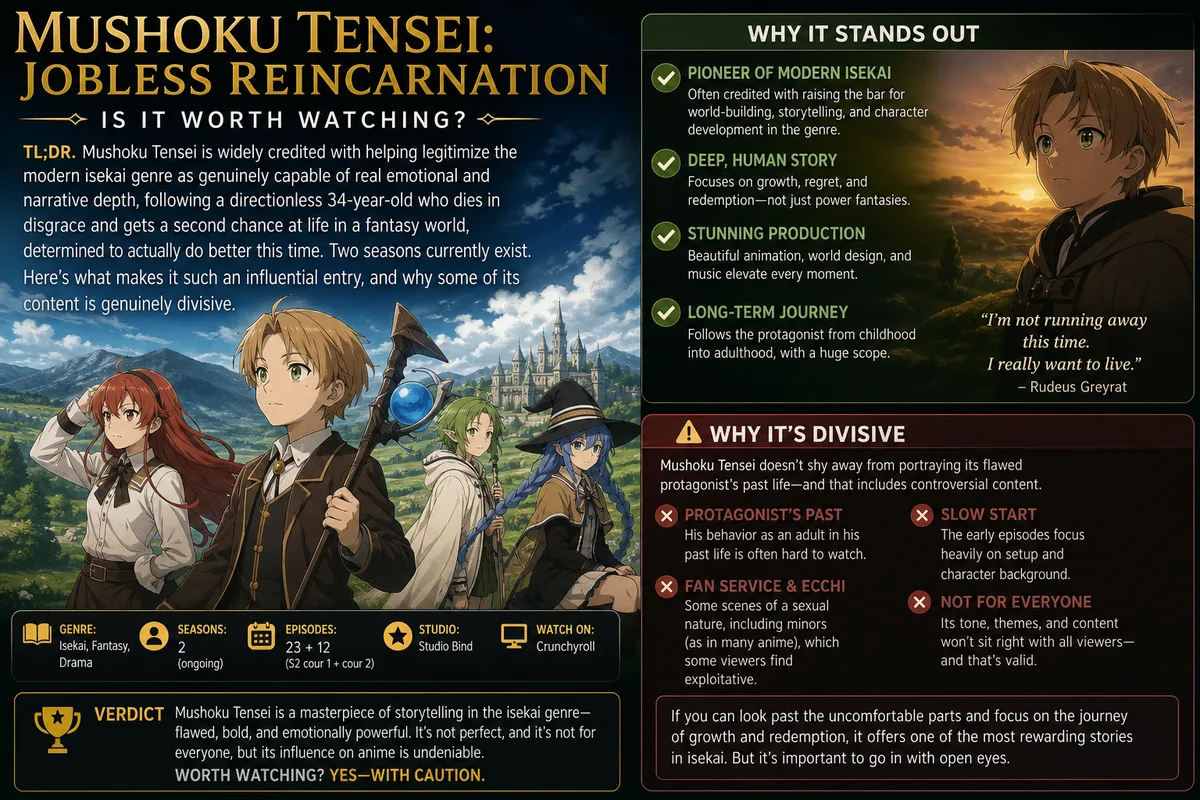
TL;DR — It depends on your tolerance for its protagonist. Mushoku Tensei (Studio Bind) is one of the best-made isekai: a huge, detailed fantasy world and a reincarnated hero who grows up over many years. But Rudeus is openly perverted, and the story sexualises underage characters at times, which many viewers can't get past. Seasons 1 and 2 are out; Season 3 began in July 2026, with a second part due in 2027.
Get anime picks based on this article
Want a big fantasy world to get lost in? Get anime picks matched to your mood.
Get anime picksTell us your mood. We'll do the picking.
8 quick questions. Real anime picks from real catalogs — not ads. Free, no sign-up.
Take the quizThe verdict
Brilliantly made, and genuinely divisive. Studio Bind was founded specifically to adapt Mushoku Tensei, and it shows: the world-building, animation and sense of time passing are among the best in any isekai. The question is whether you can accept its lead. Watch the first two or three episodes, which show both sides clearly, before you commit.
The premise
A 34-year-old shut-in, rejected by his family, dies trying to save teenagers from a truck. He's reborn as Rudeus Greyrat, a baby in a world of magic, with all his old memories. He resolves to live this life properly, and the series follows him from infancy into adulthood: training, travelling, losing people and slowly becoming someone better.
Why it's praised
- Time and growth. Characters age over years, and relationships change with them.
- World-building. Languages, races, magic systems and geography feel worked out in detail.
- Influence. The web novel is often called a founding work of the modern reincarnation isekai.
Why it's criticised
Rudeus keeps his adult lechery in a child's body, and the show often plays it for laughs, including around characters who are children. Anime News Network and others have highlighted the novel's sexualisation of underage characters. Some viewers feel his growth makes up for it over time; many don't.
Watch order
- Season 1 (January to March and October to December 2021, 25 episodes).
- Season 2 (July to September 2023 and April to July 2024), starting with the short episode 0 prologue.
- Season 3 (from July 2026; the second part is due in 2027).
Frequently asked questions
Why is Mushoku Tensei controversial? Its protagonist, Rudeus, is a reincarnated 34-year-old whose perverted thoughts and behaviour continue into his new childhood, and the source novel has been criticised for sexualising underage characters. Some viewers find the anime frames this as comedy.
Is Mushoku Tensei finished? The light novels are complete, at 26 volumes. The anime is still adapting them, with Season 3 airing from July 2026.
Want another fantasy anime?
Our anime quiz can match one to your mood, with episode counts for each pick.