Guide·Updated August 21, 2026·5 min read·By Harshit Chawla

The Promised Neverland: Is It Worth Watching?

TL;DR — The Promised Neverland's first season is one of the most tightly plotted, genuinely tense psychological thrillers modern anime has produced, and its second season is one of the more disappointing adaptation missteps in recent memory. Here's the honest, slightly complicated answer to whether it's worth watching, and how to actually navigate the show's uneven quality.

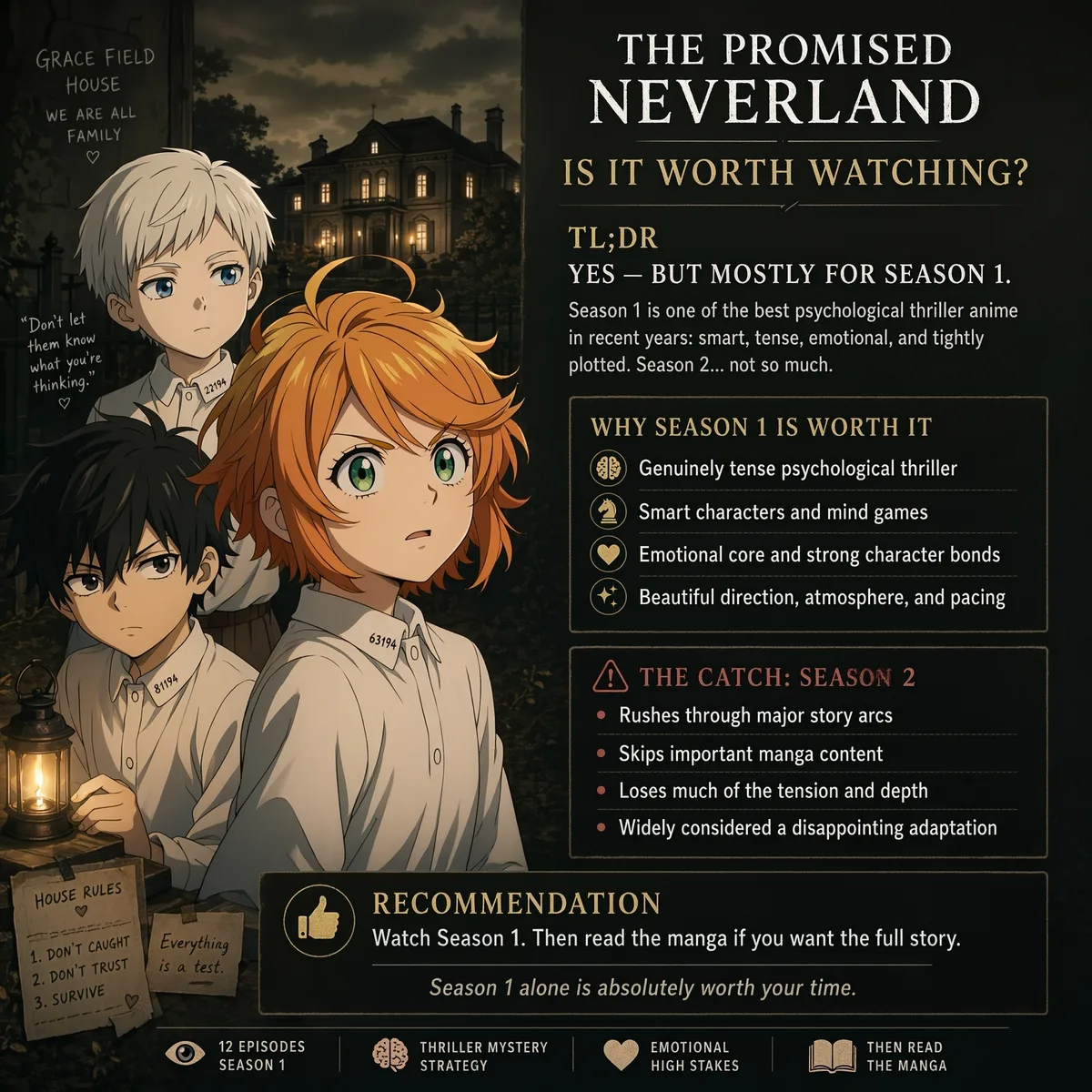
The Promised Neverland key art showing Emma, Norman, and Ray in matching orphanage uniforms outside Grace Field House at night, with a Season 1 versus Season 2 comparison.
Yes — but mostly for Season 1.

Skip ahead

Get anime recommendations based on this article

Hooked on tense, high-stakes psychological thrillers? Skip the list and jump straight to more anime with that same nerve.

Get anime picksSkips the quiz — takes you straight to a real shortlist.

Or take the quiz

Tell us your mood. We'll do the picking.

8 quick questions. Real anime picks from real catalogs — not ads. Free, no sign-up.

Take the quiz

What's the actual premise?

A group of orphans at Grace Field House, an idyllic looking orphanage, discover a devastating truth, they're being raised as food for demons, and the entire orphanage is an elaborate farm rather than a genuine home. The story follows Emma, Norman, and Ray, three of the oldest and most intelligent children, as they plan an escape while trying to protect the younger children and outsmart their caretaker, who appears loving on the surface but is fully complicit in the horrifying system.

Why is Season 1 so highly regarded?

Because it's a genuinely masterful psychological thriller, built around a cat and mouse dynamic between the children and their caretaker that ratchets up tension episode after episode without much wasted material. The show's central twist and the escalating stakes of the escape plan are handled with real precision, and the character work, particularly the shifting dynamic between Emma, Norman, and Ray as the stakes rise, gives the thriller elements genuine emotional weight rather than just plot mechanics.

What actually happened with Season 2?

This is genuinely one of the more notorious cases of an anime adaptation going wrong. Season 2 dramatically compressed a huge amount of manga material, cutting entire arcs and significant worldbuilding that fans consider essential to the story, in order to reach the ending faster. The result was widely panned by both critics and longtime manga readers as rushed, hollow, and missing the depth that made Season 1 so effective. This isn't a case of minor pacing complaints, it's considered one of the more significant disappointments in recent major anime adaptations.

Should I still watch Season 2, or is it better to switch to the manga?

If you fall in love with Season 1, and you likely will, I'd genuinely recommend switching to the manga after that point rather than continuing with Season 2. The manga contains the full, unabridged version of the story arcs that Season 2 either cuts or rushes through, and given how much fans specifically point to this as the show's biggest weakness, reading the source material is the more rewarding way to actually finish the story.

Is Season 1 worth watching even if I know I won't continue with Season 2?

Absolutely, and I'd say this firmly. Season 1 functions as a genuinely complete, self-contained arc on its own, with the escape from Grace Field House giving you a real, satisfying conclusion even if you never go further. You're not missing an incomplete story by stopping there, you're choosing to end on the show's actual strongest material.

Is this a good anime for someone who wants something genuinely tense and thriller-driven?

Yes, particularly Season 1, which delivers some of the best sustained tension in modern anime without relying on typical horror imagery or gore to generate that dread. It's much closer to a psychological thriller or an elaborate heist story than a traditional horror anime, despite its dark subject matter.

How dark is the content, and should viewers know that going in?

Genuinely dark in its premise and implications, dealing directly with themes of exploitation, captivity, and children facing mortal danger, though it's less graphically violent than the premise might suggest. The horror here is more about dread and moral horror than explicit gore.

Frequently asked questions

Is The Promised Neverland Season 1 worth watching? Yes, genuinely one of the best psychological thrillers in modern anime, and it works as a complete, satisfying watch on its own.

Is Season 2 of The Promised Neverland worth watching? Widely considered a significant disappointment, rushing through and cutting major manga content. Most fans recommend switching to the manga instead.

Can I stop after Season 1 and still feel satisfied? Yes, Season 1 concludes its central escape arc in a genuinely complete, satisfying way.

Is The Promised Neverland extremely graphic or violent? Less than its premise might suggest. The horror is more psychological and dread-based than explicitly gory.

Want something else with this kind of sustained tension?

If The Promised Neverland's psychological thriller elements appeal to you, our anime recommendation quiz can help point you toward something similar.

Related essays from the Journal

Kingdom Hearts Anime Series Announced at D23: Everything to KnowAugust 20, 2026Why do anime have filler episodes?July 12, 2026

More guides like this

Mob Psycho 100: Where to Start and What Makes It DifferentAugust 16, 2026Vinland Saga: Is It Worth Watching?August 16, 2026