Cells at Work!: What to Know Before You Start
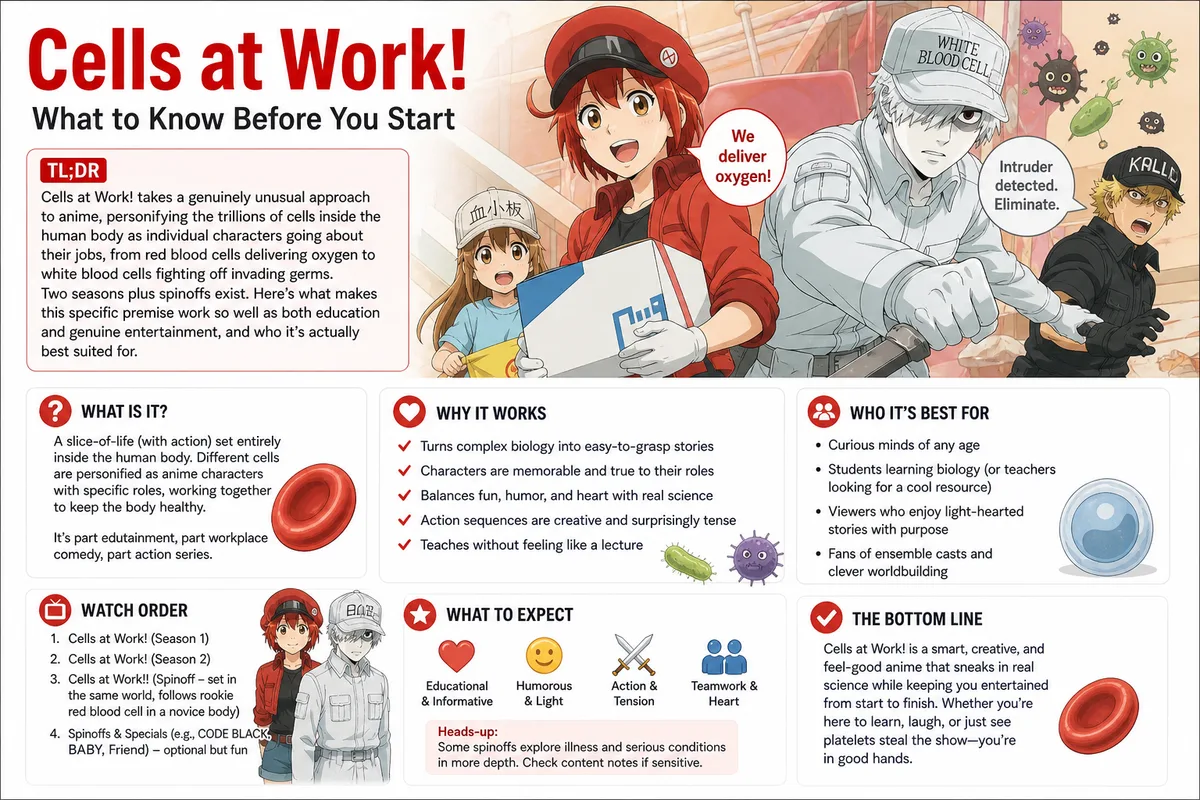
TL;DR — Cells at Work! takes a genuinely unusual approach to anime, personifying the trillions of cells inside the human body as individual characters going about their jobs, from red blood cells delivering oxygen to white blood cells fighting off invading germs. Two seasons plus spinoffs exist. Here's what makes this specific premise work so well as both education and genuine entertainment, and who it's actually best suited for.
Get anime picks based on this article
Want something genuinely educational that's also just fun? Skip the guide and jump straight to picks built for that.
Get anime picksTell us your mood. We'll do the picking.
8 quick questions. Real anime picks from real catalogs — not ads. Free, no sign-up.
Take the quizWhat's the actual premise?
Each cell within a human body is depicted as an individual worker with a specific job, Red Blood Cell AE3803 delivers oxygen throughout the body while frequently getting lost, White Blood Cell U-1146 fights off bacteria, viruses, and other pathogens with genuine, sometimes brutal efficiency, and the show follows their daily "work" as the body faces various illnesses, injuries, and everyday biological processes.
Is this show actually educational, or just a fun gimmick?
Genuinely both, and impressively so. The show accurately represents real biological processes and cell functions with real specificity, making it a genuinely popular resource used by some educators and students for its scientifically grounded depictions, while never losing sight of genuine character-driven storytelling and comedy.
Is the show appropriate for children, given its educational angle?
Largely yes for general content, though it's worth knowing the show doesn't shy away from depicting real medical crises with genuine dramatic weight, including serious illness and injury, meaning some episodes carry more emotional or intense content than the premise's cute character designs might initially suggest.
How does the show balance comedy with more serious medical content?
Genuinely well, alternating between lighter, comedic episodes depicting everyday bodily functions and genuinely tense, dramatic episodes depicting the body fighting off serious illness or injury, giving the show real tonal range beyond a purely comedic premise.
Are there spinoffs, and are they worth watching?
Yes, several, including Cells at Work! CODE BLACK, a genuinely darker, more mature spinoff depicting an unhealthy body under constant strain from poor lifestyle choices, offering a notably more intense tone than the main series. There's also Cells at Work! Baby, focused on a newborn's immune system. Each spinoff shifts the tone and target audience somewhat, so I'd research each specifically before assuming they match the main series' generally lighter register.
Is this a good anime for someone who wants something genuinely educational alongside entertainment?
Yes, genuinely one of the better options in anime for that specific combination, delivering real, accurate biological information within a genuinely engaging character-driven narrative rather than feeling like a dry educational exercise.
Is this a good anime for someone who's never watched anime before?
Yes, genuinely accessible, given its unique premise doesn't require familiarity with typical anime conventions, and its educational hook gives it broad appeal beyond typical anime audiences specifically.
Frequently asked questions
What's the actual premise of Cells at Work!? It personifies the human body's cells as individual worker characters going about their specific biological functions.
Is Cells at Work! scientifically accurate? Yes, genuinely, it's used by some educators for its accurate depiction of real biological processes.
Is this show appropriate for children? Largely yes, though some episodes depict serious illness with real dramatic weight beyond the show's cute character designs.
What is Cells at Work! CODE BLACK? A genuinely darker, more mature spinoff depicting an unhealthy body under constant strain, with a more intense tone than the main series.
How many seasons of the main series are there? Two seasons currently, plus several spinoffs with varying tones.
Is this a good pick for someone who wants education alongside entertainment? Yes, genuinely one of the stronger options in anime for that specific combination.
Is this a good first anime for someone new to the medium? Yes, its unique premise doesn't require familiarity with typical anime conventions.
Should I watch the spinoffs in a specific order relative to the main series? Not strictly required, though I'd research each spinoff's tone specifically, since some are notably more mature or intense than the main show.
Want something else with this kind of unique, inventive premise?
Our anime recommendation quiz can help you find something similar.