Parasyte -the maxim-: Is It Worth Watching in 2026?
Our verdict — 8/10, worth watching
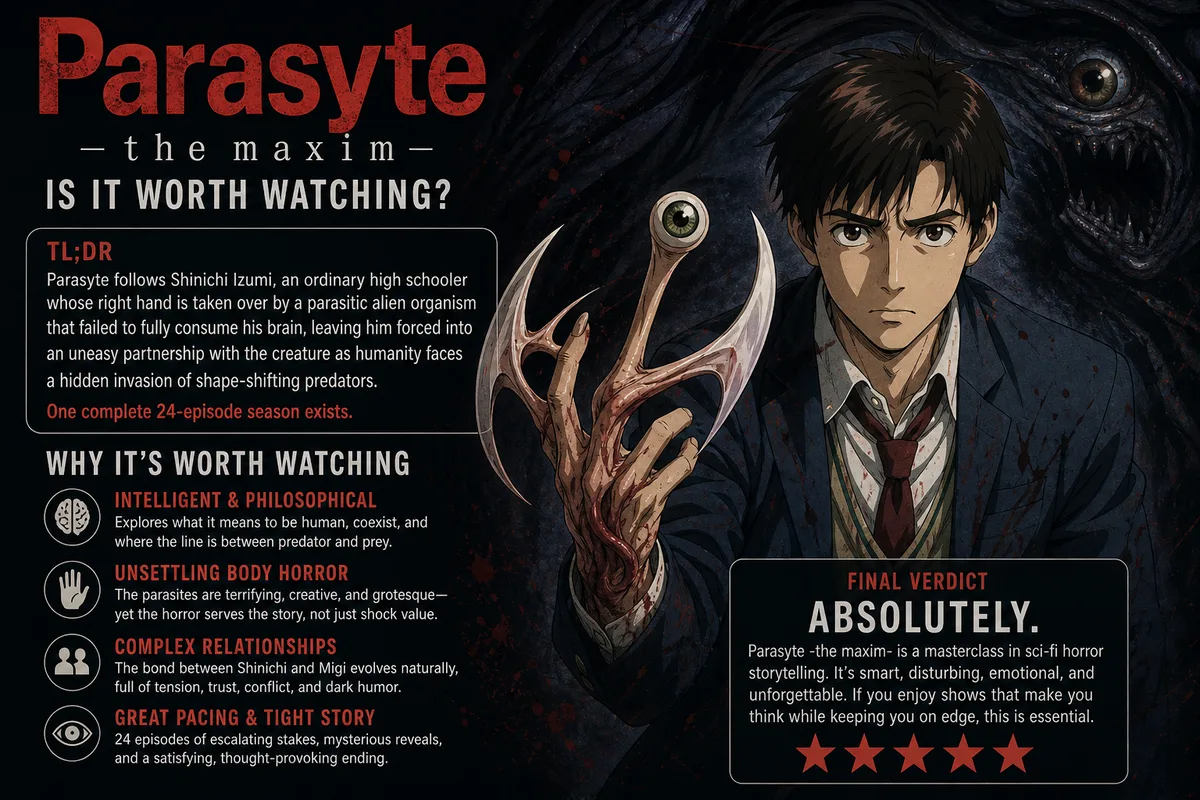
In short: Yes. Parasyte -the maxim- (Madhouse, 2014 to 2015) is 24 episodes that adapt Hitoshi Iwaaki's entire manga, so it has a real ending. A teenager's right hand is taken over by an alien parasite, and the two have to work together to survive. It's gory, but it uses the horror to ask what makes someone human. If you liked Netflix's Parasyte: The Grey, this is the original story.
Get anime picks based on this article
Want horror that makes you think? Get anime picks matched to your mood.
Get anime picksPrefer to answer a few questions? Take the 8-question anime quiz →The verdict
Worth it, and an easy recommendation. Parasyte is that rare thing: a complete, 24-episode horror series with no filler and an ending that follows through on its ideas. The animation is solid rather than spectacular, but the story and the central partnership carry it.
The premise
Small worm-like parasites fall to Earth, burrow into human heads and take over their hosts, who then quietly hunt other people. The one that targets high schooler Shinichi Izumi fails to reach his brain and takes over his right hand instead. It names itself Migi ("right"). Neither can survive without the other, so a timid boy and a coldly logical alien form an uneasy alliance while other parasites close in.
What makes it work
The heart of the show is Migi, who is curious, unsentimental and often right, and Shinichi, who becomes harder and colder as the series goes on. The question of whether he's losing his humanity, and whether humans are any less monstrous than the parasites, runs underneath every fight. The body horror is inventive, with parasites turning into blades and jaws, but it always has a point.
Anime vs manga
The anime, made by Madhouse and directed by Kenichi Shimizu, moves Iwaaki's late-1980s story to the 2010s, with smartphones and updated designs, but follows the plot closely to the end. Some fans prefer the manga's original look and its slightly darker tone, but the adaptation is widely considered faithful.
Who it suits
If you liked Tokyo Ghoul's premise but wanted a story that finishes, or Devilman Crybaby's mix of horror and humanity, start here. If gore is a dealbreaker, it isn't for you.
Frequently asked questions
Do I need to watch Parasyte before Parasyte: The Grey? No. The Grey is a standalone Korean story set in the same world, with new characters. Watching the anime first does add context.
How gory is Parasyte? Quite. The parasites split people's heads open and kill brutally, and the show doesn't look away. The violence is frequent but serves the story.
Want another smart horror anime?
Our anime quiz can match one to your mood, with episode counts for each pick.